
A Landmark Year for Computational Gastronomy
2025 marked a significant year for Computational Gastronomy, characterized by growth, geographic expansion, and the commemoration of foundational milestones.
Inaugural Conferences
This was a year of “Firsts,” witnessing the inaugural editions of three major Computational Gastronomy conferences across the globe, signaling the discipline’s rapid maturation and widening academic and commercial appeal:
| Conference Name | Affiliation | Date | Location |
| 1st Workshop on Computational Gastronomy (CoGamy): Data Science for Food and Cooking | The IEEE International Conference on Data Mining | November 12, 2025 | Washington D.C., USA |
| First International Workshop of Scientific and Computational Gastronomy | Future Cooking Laboratory, University di Parma | September 8-9, 2025 | University of Parma, Italy |
| 1st International Workshop on Multi-modal Food Computing | Co-Located with ACM Multimedia | October 27-31, 2025 | Dublin, Ireland |
A Decade of Computational Gastronomy
Amidst this flurry of new activity, the field also celebrated its enduring foundation. The oldest gathering in the discipline, the Symposium on Computational Gastronomy, marked a monumental occasion: “Ten Years of Computational Gastronomy”. This annual event will be held on December 13, 2025, at IIIT-Delhi, underscoring the longevity and deep roots of CompGas research at this institution.
CoGamy 2025 Highlights
I made the journey to Washington D.C. to participate in CoGamy 2025, held in conjunction with the IEEE International Conference on Data Mining. The workshop showcased the remarkable diversity and practical applications of research in Computational Gastronomy.

The papers presented spanned a wide spectrum of subject matter, ranging from fundamental data science challenges to direct societal impact applications. Notable topics included:
- Knowledge Representation and Cuisine: Two compelling papers generated considerable interest—and perhaps a few hunger pangs—as they were based on data compiled into the “Encyclopedia of Italian Cuisine,” a massive, comprehensive knowledge graph. This demonstrated the maturation in intersection of CompGas and Knowledge Graphs.
- Nutrition and Health: Research focused on the visual detection and analysis of food dishes, utilizing computer vision for improved nutritional tracking and dietary feedback.
- Sensory and Clinical Applications: An innovative app-based flavor model interface was presented, designed specifically to help individuals with sensory challenges (such as those undergoing chemotherapy) effectively communicate their preferences and aversions to clinicians and caregivers.
- Advanced Modeling: The conference also delved into more complex modeling techniques, including a particularly intriguing paper on aroma prediction in wine, showcasing the ability of computational methods to tackle highly subjective and covariant data.
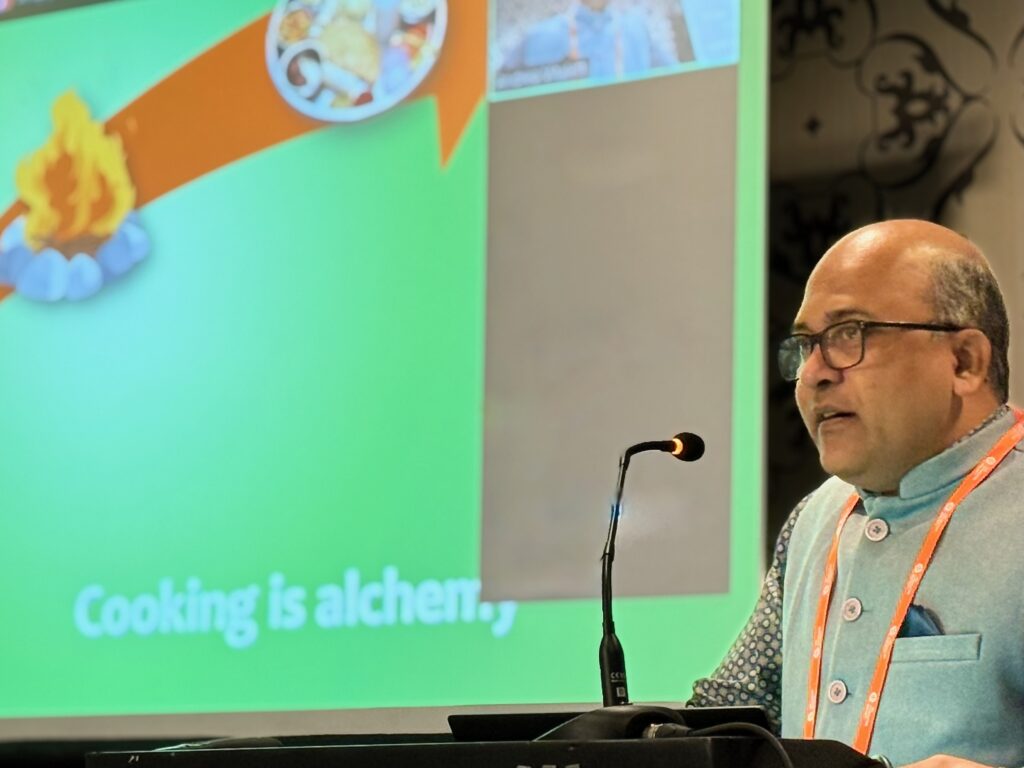
The keynote address at CoGamy 2025 was delivered by Professor Ganesh Bagler from the Complex Systems Laboratory at IIIT-Delhi. Professor Bagler is a towering figure whose contributions to the field cannot be overstated.
Not only is his lab at the forefront of research in terms of both the depth and longevity of its work, but Professor Bagler also holds the distinction of having coined the term “Computational Gastronomy” itself.
His singular research contributions have profoundly shaped the discipline. Recognizing the interdisciplinary nature and broad appeal of the subject, Bagler has consistently traveled the world, speaking on Computational Gastronomy in venues as diverse as local pubs, global TedX stages, and leading academic conferences, effectively bringing this once-niche field into the global spotlight.
Computational Gastronomy in the current AI Epoch
The surging academic and commercial interest in Computational Gastronomy is a natural fit within the current epoch of Artificial Intelligence. Modern AI systems, particularly those dealing with complex, real-world data, can benefit immensely from the deep data structures, rigorous models, and strong grounding that have been painstakingly developed within the CompGas community over the past decade plus.
It is particularly noteworthy that many of the most significant innovations in Computational Gastronomy are not fundamentally tied to specific contemporary AI trends, such as Large Language Models (LLMs).
In many cases, these innovations have proceeded independently of, and are robust enough to outlive, the “AI Du Jour,” testifying to the enduring scientific value of CompGas approaches.
Footnote: Field Trips
Beyond the presentations, the conference provided invaluable opportunities for networking and collaborative discussion. I was fortunate to spend time with computational gastronomists from around the world, engaging in informal discussions and field trips that bridged the gap between theory and practice.
Our excursions included a visit to the historic Ben’s Chili Bowl (an institution since 1957). There, over a “Half Smoke” Chili Dog, discussions ranged from complex food and culture modeling to the sociological question of how a specific dish or location “becomes an institution”. The group also visited the National Air and Space Museum, offering a moment to reflect on the broader, never-ending arc of human ingenuity – a perfect metaphor for the nascent and boundless potential of Computational Gastronomy.